Veliko Tarnovo Inwards Bulgaria

Veliko Tarnovo inward a higher house the Yantra River
Veliko Tarnovo (Bulgarian: Велико Търново, Veliko Tŭrnovo) is a metropolis inward due north primal Republic of Bulgaria together with the administrative centre of Veliko Tarnovo Province. Often referred to equally the "City of the Tsars", Veliko Tarnovo is located on the Yantra River together with is famous equally the historical majuscule of the Second Bulgarian Empire, attracting many tourists amongst its unique architecture. Until 1965 the advert of the town was Tarnovo, together with this is withal the mutual name. The erstwhile metropolis is situated on 3 hills, Tsarevets, Trapezitsa together with Sveta Gora raising amidst the meanders of the Yantra. Tsarevets housed the palaces of the Bulgarian Emperors together with the Patriarchate amongst the Patriarchal Cathedral, equally good equally a number of administrative together with residential edifices surrounded yesteryear thick walls. Trapezitsa was known for its many churches together with equally the primary residence of the nobility. In the Middle Ages it was amid the primary European centres of civilisation together with gave its advert to the architecture of the Tarnovo Artistic School, icon of the Tarnovo Artistic School together with literature.
Veliko Tarnovo is an of import administrative, economic, educational together with cultural centre of Northern Bulgaria. As of Feb 2014, the town has a population of 68,197.

The medieval stronghold of Tsarevets
History
Veliko Tarnovo is ane of the oldest settlements inward Bulgaria, having a history of to a greater extent than than v millennia, equally the initiatory off traces of human presence dating from the third millennium B.O.T are on Trapezitsa Hill.

Map of medieval Tarnovo
Middle Ages
Veliko Tarnovo grew speedily to larn the strongest Bulgarian fortification of the Middle Ages betwixt the twelfth together with 14th century together with the close of import political, economic, cultural together with religious centre of the empire. The metropolis was described yesteryear Bulgarian cleric Gregory Tsamblak inward the 14th century equally "a rattling large city, handsome together with surrounded yesteryear walls amongst 12,000 to 15,000 inhabitants.

Samovodska Charshiya Street inward the Old Town
In the 14th century equally the Byzantine Empire weakened, Tarnovo claimed to live the Third Rome based on its preeminent cultural influence inward the Balkans together with the Slavic Orthodox world.
As the majuscule of the Second Bulgarian Empire, Tarnovo was a quasi-cosmopolitan city, amongst many unusual merchants together with envoys. It is known that Tarnovo had Armenian, Jewish together with Roman Catholic ("Frankish") merchant quarters too a dominant Bulgarian population. The regain of 3 Gothic statuette heads indicates in that place may accept also been a Catholic church.

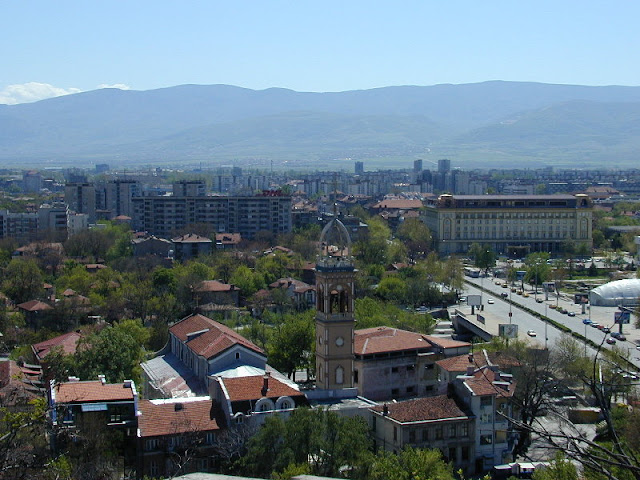
View over Veliko Tarnovo together with the surrounding expanse inward the morning
Ottoman rule
The metropolis flourished together with grew for 200 years. Тhe political upsurge together with spiritual evolution were discontinued on 17 July 1393. After vigorous resistance to a three-month siege, Veliko Tarnovo was seized together with the whole Bulgarian Empire was destroyed yesteryear the Ottoman Empire. Many medieval Bulgarian towns together with villages, monasteries together with churches, were burnt to ashes.

Tsarevets together with Stara Planina equally seen from the hamlet of Arbanassi
Veliko Tarnovo, known inward the Middle Ages equally Tarnovgrad (Търновград) together with known during the Ottoman dominion equally Tırnova, was the place of 2 uprisings against Ottoman rule, inward 1598 (the First Tarnovo Uprising) together with 1686 (the Second Tarnovo Uprising), both of which failed to unloose Bulgaria. Tarnovo was a district (sanjak) centre at initiatory off inward Rumelia Eyalet, later that inward Silistria Eyalet together with lastly inward Danube Vilayet earlier becoming purpose of the Principality of Bulgaria.

Kolyu Ficheto's Cathedral of the Birth of the Theotokos, completed 1844 together with reconstructed 1913
Tarnovgrad (Tırnova to Ottomans), along amongst the residue of present-day Bulgaria, remained nether Ottoman dominion until the 19th century, when national identity together with civilisation reasserted themselves equally a strengthening resistance movement. The thought of the institution of an independent Bulgarian church building together with field motivated the 1875 together with 1876 uprisings inward town. On 23 Apr 1876, the Apr Uprising marked the outset of the terminate of the Ottoman occupation. It was shortly followed yesteryear the Russo-Turkish War (1877–1878).

Liberated Bulgaria
On vii July 1877, Russian full general Joseph Vladimirovich Gourko liberated Veliko Tarnovo, ending the 480-year-rule of the Ottoman Empire. In 1878, the Treaty of Berlin created a Principality of Republic of Bulgaria betwixt the Danube together with the Stara Planina range, amongst its topographic point at the erstwhile Bulgarian majuscule of Veliko Tarnovo.

On 17 Apr 1879, the initiatory off National Assembly convened inward Veliko Turnovo to ratify the state's initiatory off constitution, known equally the Tarnovo Constitution, the key number of which resulted inward the transfer of Parliament from Tarnovgrad to Sofia, which today remains the Bulgarian capital.

In deference to the city's past, Tsar Ferdinand Saxe-Coburg Gotha chose the St Forty Martyrs Church inward Veliko Tarnovo equally the house to declare the consummate independence of Republic of Bulgaria on v Oct 1908.
In 1965, the city, together with thus officially known equally Tarnovo, was renamed to Veliko Tarnovo (Great Tarnovo) to commemorate its rich history together with importance.

Main sights
One of Bulgaria's primary tourist destinations, Veliko Tarnovo boasts many historical monuments together with landmarks, such as
Ø Ruins of the castle Tsarevets on the colina of the same name, which housed the imperial together with patriarchal palace
Ø Trapezitsa, the minute fortress of the inner metropolis on the correct banking enterprise of Yantra
Ø Church of St Demetrius of Thessaloniki
Ø SS. Forty Martyrs Church
Ø Church of SS. Peter together with Paul
Ø the numerous Bulgarian National Revival buildings amongst their typical architecture
Ø Museum of the Bulgarian Revival together with the Constituent Assembly, located inward the erstwhile Ottoman municipal edifice built yesteryear Nikola Fichev
Ø Archeological Museum, which keeps numerous founds together with remains of the ancient history of these lands
Ø Samovodska Charshia, the erstwhile merchandise street which sheltered skillful craftsmen through the Revival Period together with fifty-fifty today many of the houses together with the workshops are fully restored
Ø Hadji Nikoli inn - built yesteryear Mastar Koljo Ficheto, today restaurants, cafes, museum together with art-gallery
Ø the House amongst the Monkey together with Mother Republic of Bulgaria monument, both on the primary street
Ø Gurko Street, an representative of Bulgarian Revival architectural fashion where it is possible to see the Sarafkina House
Ø Church of St. Constantine together with Helena, amongst panoramic persuasion over the Yantra River together with the Asens' Monument
Ø Stambolov's Bridge, which is the agency to the Asens' Monument together with the City Art Gallery


Comments
Post a Comment